Search
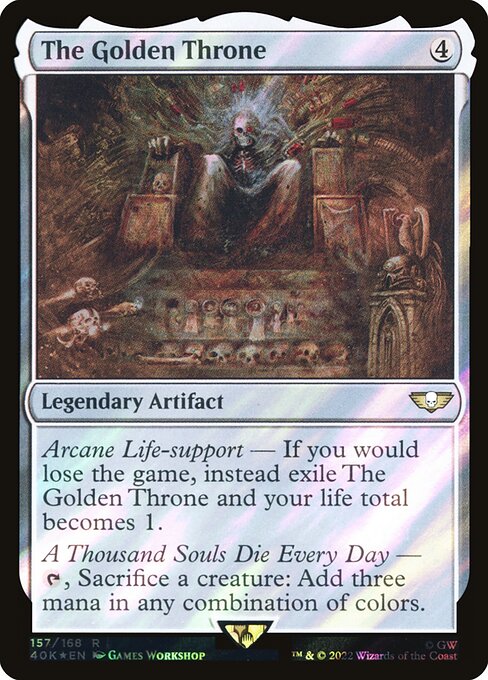
The Golden Throne
Legendary Artifact
rare
Arcane Life-support — If you would lose the game, instead exile The Golden Throne and your life total becomes 1. A Thousand Souls Die Every Day — , Sacrifice a creature: Add three mana in any combination of colors.
Semantic Tags
Benefits from creatures dying — drain effects, death triggers, and sacrifice-for-value payoffs.
Devotion-based strategies — caring about colored mana symbols in mana costs.
Benefits from creatures or permanents dying — death triggers, blood artist effects.
Cards that directly win the game or threaten to end it quickly. Includes 'you win the game' effects and massive threats.
Artifacts that produce mana. Sol Ring, Arcane Signet, Fellwar Stone.
A permanent with a repeatable activated ability that converts excess mana into value.
A card or token on the battlefield. See rule 110, “Permanents.”
One-shot mana bursts that don't persist. Dark Ritual, Seething Song, Treasure token generators used for mana.
Broadly benefits from sacrificing permanents — overlaps aristocrats but includes non-creature sacrifice.
Lets you sacrifice your own creatures or permanents for value. Key enabler for aristocrats strategies.
Format Legality
Price history
Loading price history…
Printings (2)
| Set | Rarity | TCGplayer | Card Kingdom | Cardmarket |
|---|---|---|---|---|
| Warhammer 40,000 Commander#157★ | rare | · | · | · |
| Warhammer 40,000 Commander#157 | rare | · | · | · |
Related Rules
If an ability would produce one or more mana of an undefined type, it produces no mana instead.
Some abilities produce mana based on the type of mana another permanent or permanents “could produce.” The type of mana a permanent could produce at any time includes any type of mana that an ability of that permanent would produce if the ability were to resolve at that time, taking into account any applicable replacement effects in any possible order. Ignore whether any costs of the ability could or could not be paid. If that permanent wouldn’t produce any mana under these conditions, or no type of mana can be defined this way, there’s no type of mana it could produce.
To “tap [a permanent] for mana” is to activate a mana ability of that permanent that includes the {T} symbol in its activation cost. See rule 605, “Mana Abilities.”
An ability that triggers whenever a permanent “is tapped for mana” or is tapped for mana of a specified type triggers whenever such a mana ability resolves and produces mana or the specified type of mana.
A replacement effect that applies if a permanent “is tapped for mana” or tapped for mana of a specific type and/or amount modifies the mana production event while such an ability is resolving and producing mana or the specified type and/or amount of mana.
If an object’s enters-the-battlefield triggered ability or replacement effect refers to X, and the spell that became that object as it resolved had a value of X chosen for any of its costs, the value of X for that ability is the same as the value of X for that spell, although the value of X for that permanent is 0. This is an exception to rule 107.3i.
The tap symbol is {T}. The tap symbol in an activation cost means “Tap this permanent.” A permanent that’s already tapped can’t be tapped again to pay the cost. A creature’s activated ability with the tap symbol in its activation cost can’t be activated unless the creature has been under its controller’s control continuously since their most recent turn began. See rule 302.6.
The untap symbol is {Q}. The untap symbol in an activation cost means “Untap this permanent.” A permanent that’s already untapped can’t be untapped again to pay the cost. A creature’s activated ability with the untap symbol in its activation cost can’t be activated unless the creature has been under its controller’s control continuously since their most recent turn began. See rule 302.6.
Rulings
If a spell or ability both destroys The Golden Throne and deals enough damage to you to reduce your life total to zero or less, you will still lose the game. This is because the state-based action that causes a player to lose the game due to having zero or less life won't be performed until after the spell or ability finishes resolving. At that point, The Golden Throne is no longer on the battlefield to apply its replacement effect.
In a Two-Headed Giant game, The Golden Throne's ability set's the team's life total to 1, but only you gain or lose life.
If an effect says that you can't lose the game, The Golden Throne's first ability doesn't apply.
If an effect states that an opponent wins the game, The Golden Throne's effect doesn't apply.
For your life total to become 1, you will gain or lose the appropriate amount of life. For example, if your life total is -4 when The Golden Throne's ability applies, it will cause you to gain 5 life. Alternatively, if your life total is 20 when it applies (perhaps because you tried to draw a card from an empty library), you will lose 19 life. Other cards that interact with life gain or life loss will interact with this effect accordingly. Notably, this means that if you can't gain life or the life gain event is modified by another replacement effect, you might still have 0 or less life and still lose the game.
The Golden Throne's effect applies any time you would lose the game while it is on the battlefield, even if you're not losing due to your life total being 0 or less. If you would have lost the game because you tried to draw from an empty library, your life total becomes 1 and you won't lose again until you try to draw again and still can't do so. If you would have lost the game due to having ten or more poison counters, your life total becomes 1, but you will lose the game immediately afterward because you still have ten or more poison counters.
The Golden Throne's effect does nothing if you concede the game. A player who concedes leaves the game.