Search
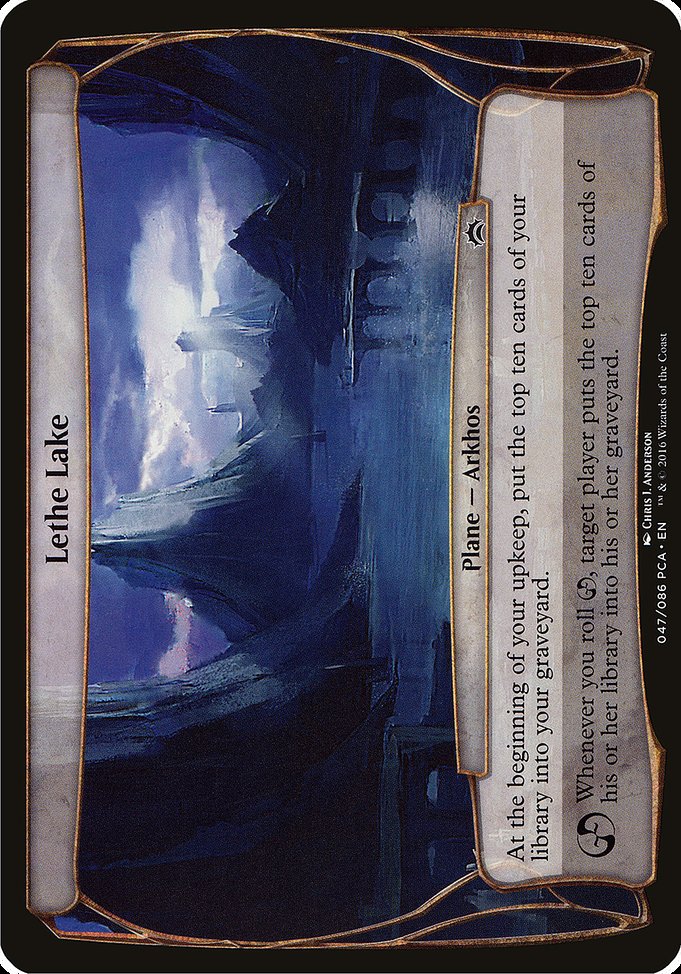
Lethe Lake
Plane — Arkhos
common
At the beginning of your upkeep, mill ten cards. Whenever chaos ensues, target player mills ten cards.
 Card Kingdom
 Cardmarket
Semantic Tags
To mill a number of cards, a player puts that many cards from the top of their library into their graveyard. See rule 701.17.
An effect that puts cards from your own library into your graveyard for value.
An effect that puts cards from your own library into your graveyard for value.
Format Legality
Price history
Loading price history…
Printings (2)
| Set | Rarity | TCGplayer | Card Kingdom | Cardmarket |
|---|---|---|---|---|
| Planechase Anthology Planes#47 | common | · | · | · |
| Planechase Planes#21 | common | · | · | · |
Related Concepts
Related Rules
While applying a replacement effect that modifies how a permanent enters the battlefield, another replacement effect may cause a player to mill cards or exile cards from the top of a library. In that case, any card that is entering the battlefield from that library won’t be included in that effect, even though those cards are in the library as the effect is applied.
Mill
For a player to mill a number of cards, that player puts that many cards from the top of their library into their graveyard.
A player can’t mill a number of cards greater than the number of cards in their library. If given the choice to do so, they can’t choose to take that action. If instructed to do so, they mill as many as possible. Similarly, the player can’t pay a cost that includes milling a number of cards greater than the number of cards in their library.
Dredge is a static ability that functions only while the card with dredge is in a player’s graveyard. “Dredge N” means “As long as you have at least N cards in your library, if you would draw a card, you may instead mill N cards and return this card from your graveyard to your hand.”
A player with fewer cards in their library than the number required by a dredge ability can’t mill any of them this way.
If a trigger event includes an object moving out of or into a player’s range of influence, use the game state before or after the event as appropriate to determine whether the triggered ability will trigger. See rules 603.6 and 603.10.
Rulings
A face-up plane card that's turned face down becomes a new object with no relation to its previous existence. In particular, it loses all counters it may have had.
If an ability of a plane refers to "you," it's referring to whoever the plane's controller is at the time, not to the player that started the game with that plane card in their deck. Many abilities of plane cards affect all players, while many others affect only the planar controller, so read each ability carefully.
If you don't have ten cards in your library, you'll put all the cards in your library into your graveyard. The same is true if the targeted player doesn't have ten cards in their library.
A plane card is treated as if its text box included "When you roll {PW}, put this card on the bottom of its owner's planar deck face down, then move the top card of your planar deck off that planar deck and turn it face up." This is called the "planeswalking ability."
The controller of a face-up plane card is the player designated as the "planar controller." Normally, the planar controller is whoever the active player is. However, if the current planar controller would leave the game, instead the next player in turn order that wouldn't leave the game becomes the planar controller, then the old planar controller leaves the game. The new planar controller retains that designation until they leave the game or a different player becomes the active player, whichever comes first.