Search
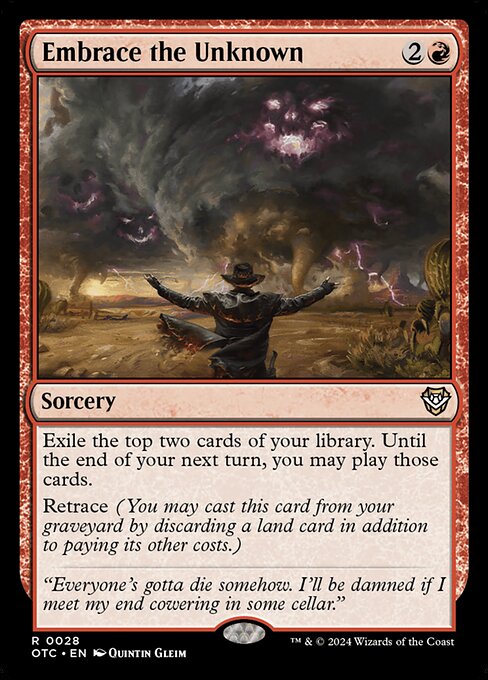
Embrace the Unknown
Sorcery
rare
Exile the top two cards of your library. Until the end of your next turn, you may play those cards. Retrace (You may cast this card from your graveyard by discarding a land card in addition to paying its other costs.)
 Card Kingdom
 Cardmarket
Semantic Tags
A keyword ability that allows a player to cast a double-faced card transformed from the graveyard. See rule 702.146, “Disturb.”
A keyword ability that lets a player return a card from their graveyard to their hand. See rule 702.52, “Dredge.”
Cares about cards in the graveyard, puts cards into the graveyard, or benefits from things dying.
Exile-based card advantage — exile cards from the top of your library and cast them temporarily. Red's primary draw mechanic.
Storm count strategies — casting many spells in a single turn for storm triggers.
Format Legality
Price history
Loading price history…
Printings (2)
| Set | Rarity | TCGplayer | Card Kingdom | Cardmarket |
|---|---|---|---|---|
| Outlaws of Thunder Junction Commander#28 | rare | · | · | · |
| Outlaws of Thunder Junction Commander#64 | rare | · | · | · |
Related Concepts
Related Rules
Dredge
Dredge is a static ability that functions only while the card with dredge is in a player’s graveyard. “Dredge N” means “As long as you have at least N cards in your library, if you would draw a card, you may instead mill N cards and return this card from your graveyard to your hand.”
A player with fewer cards in their library than the number required by a dredge ability can’t mill any of them this way.
Retrace
Retrace is a static ability that functions while the card with retrace is in a player’s graveyard. “Retrace” means “You may cast this card from your graveyard by discarding a land card as an additional cost to cast it.” Casting a spell using its retrace ability follows the rules for paying additional costs in rules 601.2b and 601.2f–h.
Disturb
Disturb is an ability found on the front face of some double-faced cards (see rule 712, “Double-Faced Cards”). “Disturb [cost]” means “You may cast this card transformed from your graveyard by paying [cost] rather than its mana cost.” See rule 712.8c.
A resolving double-faced spell that was cast using its disturb ability enters the battlefield with its back face up.
Rulings
If the active player casts a spell that has retrace, that player may cast that card again after it resolves, before another player can remove the card from the graveyard. The active player has priority after the spell resolves, so they can immediately cast a new spell. Since casting a card with retrace from the graveyard moves that card onto the stack, no one else would have the chance to affect it while it’s still in the graveyard.
You pay all costs and follow all normal timing rules for cards played from exile this way. For example, if an exiled card is a land card, you may play it only during your main phase while the stack is empty.
Casting a card by using its retrace ability works just like casting any other spell, with two exceptions: You’re casting it from your graveyard rather than your hand, and you must discard a land card in addition to any other costs.
When a retrace spell you cast from your graveyard resolves, fails to resolve, or is countered, it’s put back into your graveyard. You may use the retrace ability to cast it again.
A retrace card cast from your graveyard follows the normal timing rules for its card type.