Search
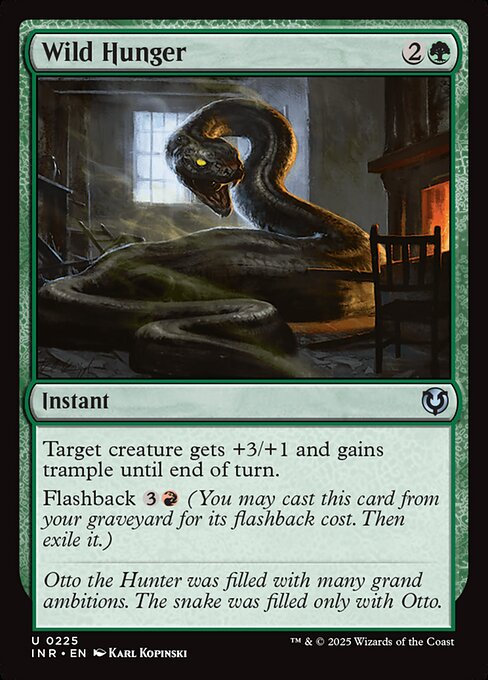
Wild Hunger
Instant
uncommon
Target creature gets +3/+1 and gains trample until end of turn. Flashback (You may cast this card from your graveyard for its flashback cost. Then exile it.)
 Card Kingdom
 Cardmarket
Semantic Tags
A keyword ability that may let a player cast a random extra spell for no cost. See rule 702.85, “Cascade.”
An instant-speed spell that modifies combat — pump, protection, or removal during combat.
An instant-speed spell that modifies combat — pump, protection, or removal during combat.
A keyword ability found on creature cards that allows them to be cast for an alternative cost. See rule 702.109, “Dash.”
A keyword ability that lets a player play a card any time they could cast an instant. See rule 702.8, “Flash.”
Flash-focused strategy — playing at instant speed for tempo and information advantage.
A keyword ability that lets a player cast a card from their graveyard. See rule 702.34, “Flashback.”
A keyword ability that lets a player cast a card from their graveyard. See rule 702.34, “Flashback.”
Cares about cards in the graveyard, puts cards into the graveyard, or benefits from things dying.
Returns cards from the graveyard to your hand, the battlefield, or the top of your library.
A spell or ability that gives a temporary power/toughness boost.
Format Legality
Price history
Loading price history…
Printings (5)
| Set | Rarity | TCGplayer | Card Kingdom | Cardmarket |
|---|---|---|---|---|
| Innistrad Remastered#225 | uncommon | · | · | · |
| Innistrad Remastered#424 | uncommon | · | · | · |
| The List#DKA-132 | common | · | · | · |
| Ultimate Masters#193 | uncommon | · | · | · |
| Dark Ascension#132 | common | · | · | · |
Related Concepts
Related Rules
Cascade
Subtypes of each card type except creature and plane are always single words and are listed after a long dash. Each word after the dash is a separate subtype. Subtypes of creature cards are one or two words and are listed after a long dash. Each word or two-word phrase, as listed in rule 205.3m, is a separate subtype. Objects other than planes may have multiple subtypes. Subtypes of planes are also listed after a long dash, but may be multiple words; all words after the dash are, collectively, a single subtype.
Artifact subtypes are always a single word and are listed after a long dash: “Artifact — Equipment.” Artifact subtypes are also called artifact types. Artifacts may have multiple subtypes. See rule 205.3g for the complete list of artifact types.
Creature subtypes are usually a single word long and are listed after a long dash: “Creature — Human Soldier,” “Artifact Creature — Golem,” and so on. Creature subtypes are also called creature types. Creatures may have multiple subtypes. See rule 205.3m for the complete list of creature types.
Enchantment subtypes are always a single word and are listed after a long dash: “Enchantment — Shrine.” Each word after the dash is a separate subtype. Enchantment subtypes are also called enchantment types. Enchantments may have multiple subtypes. See rule 205.3h for the complete list of enchantment types.
Instant subtypes are always a single word and are listed after a long dash: “Instant — Arcane.” Each word after the dash is a separate subtype. The set of instant subtypes is the same as the set of sorcery subtypes; these subtypes are called spell types. Instants may have multiple subtypes. See rule 205.3k for the complete list of spell types.
Land subtypes are always a single word and are listed after a long dash. Land subtypes are also called land types. Lands may have multiple subtypes. See rule 205.3i for the complete list of land types.
Planeswalker subtypes are always a single word and are listed after a long dash: “Planeswalker — Jace.” Each word after the dash is a separate subtype. Planeswalker subtypes are also called planeswalker types. Planeswalkers may have multiple subtypes. See rule 205.3j for the complete list of planeswalker types.
Rulings
"Flashback [cost]" means "You may cast this card from your graveyard by paying [cost] rather than paying its mana cost" and "If the flashback cost was paid, exile this card instead of putting it anywhere else any time it would leave the stack."
You must still follow any timing restrictions and permissions, including those based on the card's type. For instance, you can cast a sorcery using flashback only when you could normally cast a sorcery.
If a card with flashback is put into your graveyard during your turn, you can cast it if it's legal to do so before any other player can take any actions.
A spell cast using flashback will always be exiled afterward, whether it resolves, is countered, or leaves the stack in some other way.
To determine the total cost of a spell, start with the mana cost or alternative cost (such as a flashback cost) you're paying, add any cost increases, then apply any cost reductions. The mana value of the spell is determined only by its mana cost, no matter what the total cost to cast the spell was.
You can cast a spell using flashback even if it was somehow put into your graveyard without having been cast.